
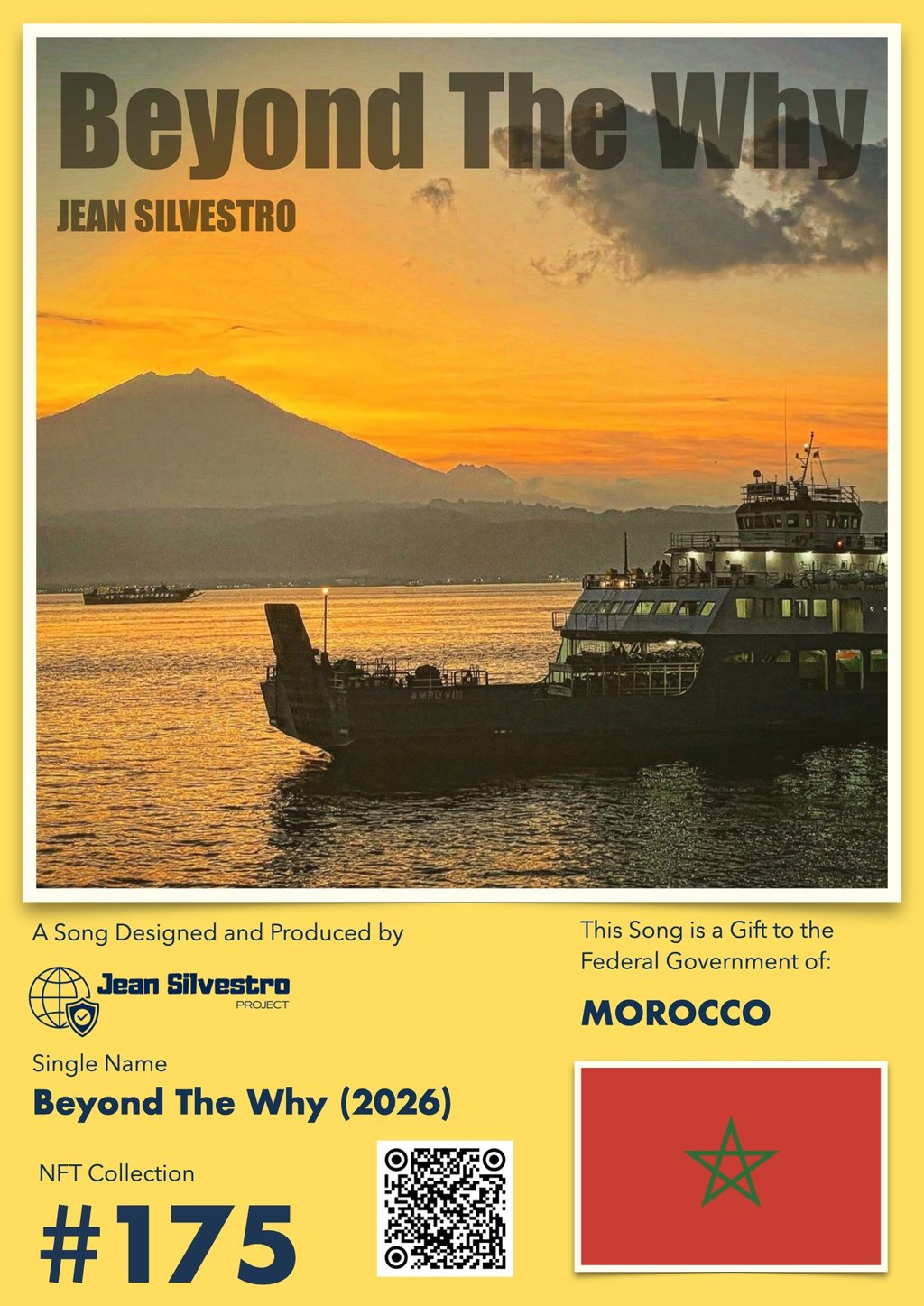
#175 Beyond The Why (2026)
Lyrics
Through the skies,
Looking for the stars
Questions burn like deep hidden scars
The echoes rise, but fade away
No truth will remain at break of day
A voice inside calls me
Break the chains
And then you’ll be free
I see the crowd, their eyes in chains
Bound by the need to name their pains
But on this path, I choose the flow,
To walk the fire and let it grow
The echoes rise, but fading away
No truth remains at break of the day
No reason binds
No fear can tie
No fate no more hide
Now just open sky
Beyond the why, I rise tonight,
In flames of freedom, burning bright
Beyond the why, I rise tonight,
In flames of freedom, burning bright
Embrace the void, eternity
A voice inside, it calls to me,
“Embrace the void, eternity.”
The heart reveals what reason hides
I let the moment call my name
Through storm and silence, I will fly
A soul unchained, beyond the why…
The echoes rise, but fading away
No truth remains at break of the day
No reason binds
No fear can tie
No fate no more hide...
Beyond the why, I rise tonight,
In flames of freedom, burning bright
Beyond the why, I rise tonight,
In flames of freedom, burning bright
The echoes rise, but fading away
No truth remains at break of the day
No reason binds
No fear can tie
No fate no more hide
Now just open sky
“Embrace the void, eternity.”
The Secret and Inspiration
Henrik Adler was born in Hamburg, in northern Germany, amidst a culture of precision, punctuality, and well-constructed answers. At fifty, his gaze reflected the exhaustion of someone who had fulfilled all expected milestones: a solid education, a respectable career in economic consulting, a minimalist apartment, trips planned months in advance. Yet, something had failed. Not in his biography—but in the invisible fabric that sustains the idea of meaning. The world continued to debate markets while children died of hunger across entire continents. The system he had served with discipline seemed too sophisticated to perceive its own cruelty.
The unease didn't arise as revolt, but as weariness. Questions began to erode his silences: why so much calculation, if suffering persisted? What were theories about progress for, if dignity wasn't universal? No answer survived the dawn. Every certainty seemed like an echo dissolving in the cold light of reason. And it was in this emptiness that he decided to leave for Marrakech, in the heart of Morocco—not as a tourist, but as someone who no longer trusted his own map. The city greeted him with the golden weight of dust suspended in the air. The pink walls reflected the sun as if guarding centuries of silence. In the souks, the smell of tanned leather mingled with saffron, cinnamon, and cumin; fabrics hung like flags of impossible colors; the vendors spoke with a musicality that seemed to dissolve borders. At dusk, the muezzin's call pierced the open sky, not as an imposition, but as a collective breath. There, faith was not an argument—it was rhythm.
Henrik walked through the narrow alleyways as if traversing an inner labyrinth. He observed children running barefoot, women balancing baskets, men sitting in small cafes serving mint tea in delicate glasses. There was evident poverty, but also a presence he lacked in Europe: an intensity of life that asked no justification. That disconcerted him more than any misery.
It was in a small, makeshift school in a peripheral neighborhood that he met Amina. She didn't speak of need; She spoke of possibility. She dressed simply, her eyes held a serenity that was not to be confused with resignation. She cared for children who barely had notebooks, teaching them letters and numbers as if offering seeds. She didn't seem interested in accumulating anything beyond shared time.
Between them there was no romance in the usual sense. There was recognition. Amina perceived his unease without him needing to explain it. “You're looking for answers that are too grand,” she told him once, while serving warm bread with olive oil and olives. “Here, we learn to take care of what fits in our hands.” Henrik didn't know how to answer. For the first time, he didn't want to answer.
He decided to help her. He used part of his savings to expand the space, buy basic food, and ensure that at least some children had two meals a day. The project was modest—almost invisible in the face of the vastness of global suffering—but concrete. Each dish served seemed to contradict years of abstract reports.
Even so, the questions returned at night. What good was a small gesture in a disproportionate world? The mind insisted on measuring impact, calculating reach, demanding structural coherence. Amina, on the contrary, spoke of presence. “The universe doesn’t ask for greatness from us,” she said. “It asks for attention.”
The event that transformed him occurred on a sweltering summer afternoon. A boy named Youssef, frail and silent, arrived at school more dejected than usual. His fever was evident. Without adequate resources, they improvised care, sought help, did what they could. Henrik held the boy’s small hand as the sun bent over the terracotta rooftops.
Youssef didn’t survive. Death was simple, almost discreet, as if the world didn’t have time to notice. Henrik felt the crushing weight of powerlessness—all his knowledge, all his logic, all his indignation were unable to alter that outcome. For the first time, he didn’t seek an explanation. He simply remained there, breathing beside Amina, while the call to prayer echoed through the city.
That night, under an incredibly clear sky, he understood something no theory had offered him: life doesn't require justification for existing. It happens—brutal, beautiful, untamed. He was insignificant before the cosmic vastness, a speck of dust suspended in the immensity. And, paradoxically, this insignificance liberated him. He didn't need to save the world. He needed to be whole wherever he was.
Henrik didn't abandon the project. He didn't find definitive answers. He found something rarer: acceptance. The pain didn't disappear, but it ceased to be a problem to solve and became part of the fabric of existence. In Marrakech, amidst the golden dust and the distant sound of prayers, he learned that going beyond the "why" isn't giving up on thinking—it's allowing—To live in harmony with what is, without judgment, without calculation, simply being present.
Morocco - Performance
Each country profile presents the most recent data available on a range of indicators relating to the well-being of women and children. Each country profile page is composed of data from multiple sources, depending on the indicator domain. For example, child mortality rates come from the most recent data produced by the UNICEF-led Inter-agency Group for Child Mortality Estimation (IGME).
SDG indicators related to children
The 2030 Agenda includes 17 Global Goals addressing the social, economic and environmental dimensions of sustainable development. Attached to the Goals are 169 concrete targets measured by 232 specific indicators.
To map and monitor how ambitious and realistic countries’ targets are, UNICEF has created quantifiable country-level benchmarks for child-related indicators for which data are available to measure and monitor child rights on a common scale.
Below is a snapshot of the country’s performance against the 45 child-related SDG indicators, grouping results into five areas of child well-being to provide an overall assessment of how children are doing. Countries are assessed using global and national targets. The analysis provides valuable insights into both historical progress—recognizing the results delivered by countries in the recent past—and how much additional effort may be needed to achieve the child-related SDG targets. This approach provides a framework for assessing ambition as well as the scale of action needed to achieve it.
Jean Silvestro Project • 2025 • All Rights Reserved
The project is currently in the institutional consolidation phase, with legal and structural developments underway.