
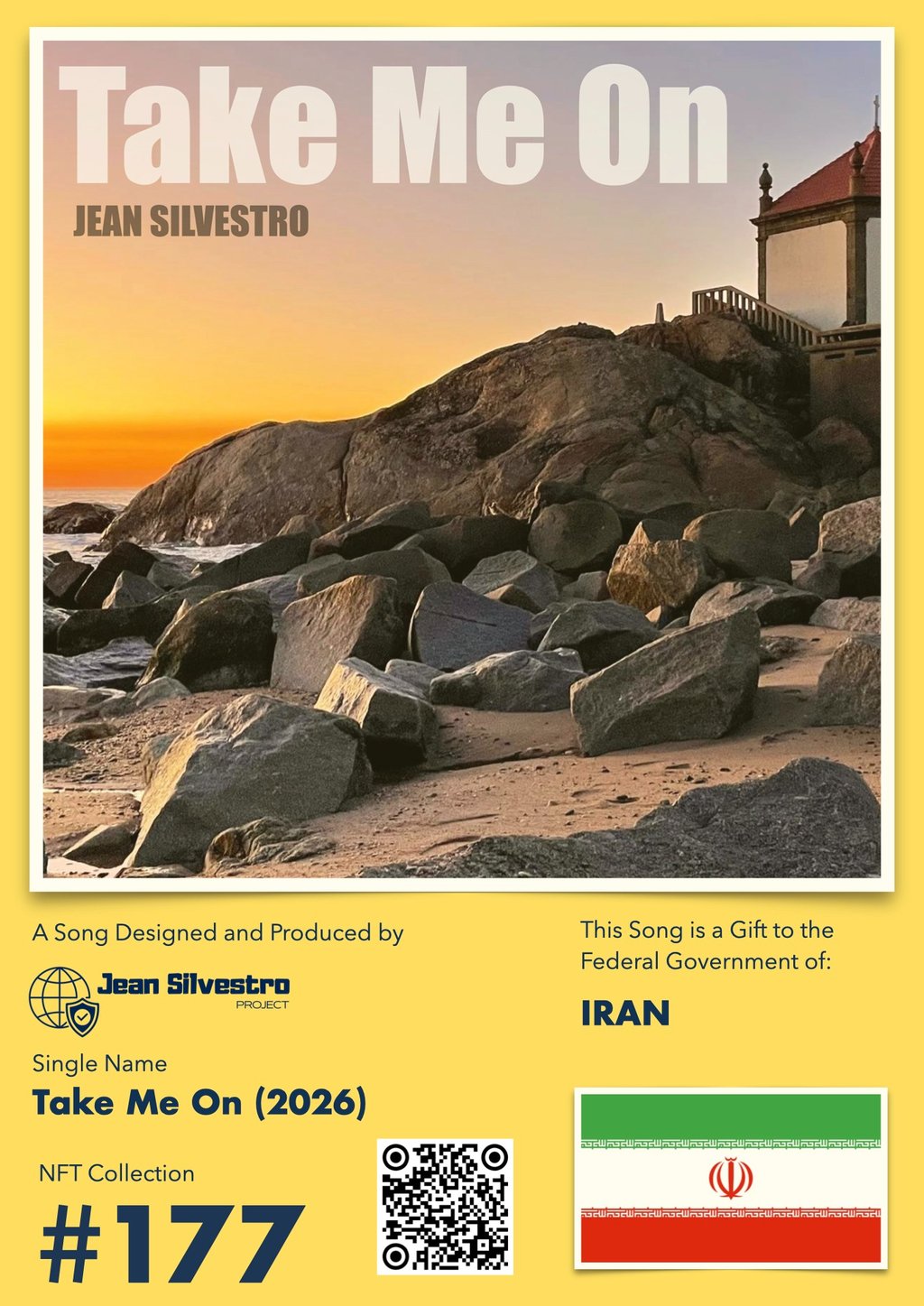
#177 Take Me On (2026)
Lyrics
Im walking here about today
Dreaming up our love again
Where did I go wrong
I'm confused and lost alone
Other lips can't warm my cold
Why don't you leave my mind?
I wanna be by your side
Without you I cannot survive
You can chain me for a dare
I could live as your prisoner
You leave inside me
You are peace of the sky
Why did you leave my life?
Why don't you take me on
Give me another chance
Tell me you gonna stay
Why don't you take me on
Take me by surprise
Stay here by my side
I wanna be by your side
Without you I cannot survive
You can chain me for a dare
I could live as your prisoner
You leave inside me
You are peace of the sky
Why did you leave my life?
Why don't you take me on
Give me another chance
Tell me you gonna stay
Why don't you take me on
Take me by surprise
Stay here by my side
Why don't you take me on
Give me another chance
Tell me you gonna stay
Im walking here about today
Dreaming up our love again
Where did I go wrong
I'm confused and lost alone
Other lips can't warm my cold
Why don't you leave my mind?
Why don't you take me on
Give me another chance
Tell me you gonna stay
Why don't you take me on
Take me by surprise
Stay here by my side
The Secret and Inspiration
Tehran is not a city that asks for permission. It imposes itself. Between the Alborz Mountains and the dense concrete of its gray buildings, the capital pulsates with a tension that doesn't appear on postcards. The traffic is chaotic, the bazaars smell of saffron and gasoline, the calls to prayer echo from the mosques while hidden satellite dishes pick up forbidden signals. It was there, among the discreet cafes of the Tajrish neighborhood and invisible diplomatic corridors, that Jennifer fell in love with Amir Rahimi.
She arrived as an American journalist, accredited to cover the negotiations on the Iranian nuclear program. Washington was applying pressure, sanctions were increasing, IAEA reports were circulating in secret, and Tehran was feigning normalcy while negotiating on the edge. Jennifer wanted to tell the story beyond the headlines. Amir appeared as a cultural translator, intermediary, guide—someone who seemed to know only both worlds. He spoke English with a slight accent, quoted Persian poetry, and drove through congested avenues as if nothing could harm him.
But Amir wasn't just a cultured man. He was young, promising, recruited years earlier out of family necessity. His father, ill, needed expensive treatment. The Guard offered stability, salary, protection. He accepted. He rose within the structure, becoming a strategic piece in counterintelligence. When he met Jennifer, he knew he was crossing an invisible line.
Jennifer walked the streets thinking: “I’m walking here about today, dreaming up our love again.” She relived the nights on the terrace of his apartment, the cold wind descending from the mountains, the city lights trembling in the distance. Amir touched her hand with physical intensity, almost urgent. Their love was unrestrained; it was body, it was breath, it was risk.
The crisis escalated. Information leaked. A laboratory sabotaged. An American diplomat expelled. Secret reports indicated foreign infiltration. Amir received a dossier. Name: Jennifer Cole. Profession: journalist. Classification: potential indirect risk. He read each line as if he were being slowly executed. There was no proof of espionage. But there was too much closeness.
He called her to a discreet café near Vanak Square. The air smelled of strong coffee and tobacco. He didn't touch her. He didn't smile. He said what they had was a mistake. He said he didn't love her. He said it was all just a distraction. Every sentence was calculated to hurt. Jennifer felt the ground open up beneath her. "Where did I go wrong?" echoed in her mind.
She tried to grab his arm. Amir pulled away. He knew he was being watched. He knew that any hesitation could put her under formal surveillance. He needed her to hate him. He needed her to leave the country. "Other lips can't warm my cold," she thought later, alone in the hotel, looking at the mountains through the window. No hug could replace his.
The nuclear tension became world headline news. Washington threatened new sanctions. Tehran responded with fiery speeches. Amir participated in meetings where maps, routes, and names were discussed like chess pieces. He protected the state, he protected his family, but he destroyed his own heart. He could never tell the truth. He could never say that his isolation was for protection.
Jennifer began to suspect. She cross-referenced information, noticed inconsistencies. One day she found an open file on his laptop—codes, reports, military terms. There was no doubt. He was not just an ordinary man. He chose not to explain. He chose silence. She left Iran weeks later, escorted by an increasingly hostile diplomatic climate.
On the plane, looking at the sky over the Persian Gulf, the music echoed in her mind like a plea: “Why don’t you take me on, give me another chance…” She wanted him to show up at the airport. She wanted him to say it was all a lie. But he didn't come.
Tehran continued to breathe under sanctions and speeches. Amir rose in the hierarchy. He became colder, more strategic. Sometimes he would drive at night along the city's wide avenues and remember her touch. He knew they could never see each other again. He knew that any reunion would be interpreted as betrayal.
Years later, Jennifer still walked alone through different cities, covering other conflicts. The love in Tehran remained suspended in time, like glass that should never break. He chose the country. She chose the truth. Between Washington and Tehran, between enriched uranium and secret reports, two bodies loved each other intensely—and were separated by forces neither could face. She still thinks: "Without you I cannot survive." But she survives. And so does he. On opposite sides of a world that never allows certain loves to exist.
Iran - Performance
Each country profile presents the most recent data available on a range of indicators relating to the well-being of women and children. Each country profile page is composed of data from multiple sources, depending on the indicator domain. For example, child mortality rates come from the most recent data produced by the UNICEF-led Inter-agency Group for Child Mortality Estimation (IGME).
SDG indicators related to children
The 2030 Agenda includes 17 Global Goals addressing the social, economic and environmental dimensions of sustainable development. Attached to the Goals are 169 concrete targets measured by 232 specific indicators.
To map and monitor how ambitious and realistic countries’ targets are, UNICEF has created quantifiable country-level benchmarks for child-related indicators for which data are available to measure and monitor child rights on a common scale.
Below is a snapshot of the country’s performance against the 45 child-related SDG indicators, grouping results into five areas of child well-being to provide an overall assessment of how children are doing. Countries are assessed using global and national targets. The analysis provides valuable insights into both historical progress—recognizing the results delivered by countries in the recent past—and how much additional effort may be needed to achieve the child-related SDG targets. This approach provides a framework for assessing ambition as well as the scale of action needed to achieve it.
Jean Silvestro Project • 2025 • All Rights Reserved
The project is currently in the institutional consolidation phase, with legal and structural developments underway.