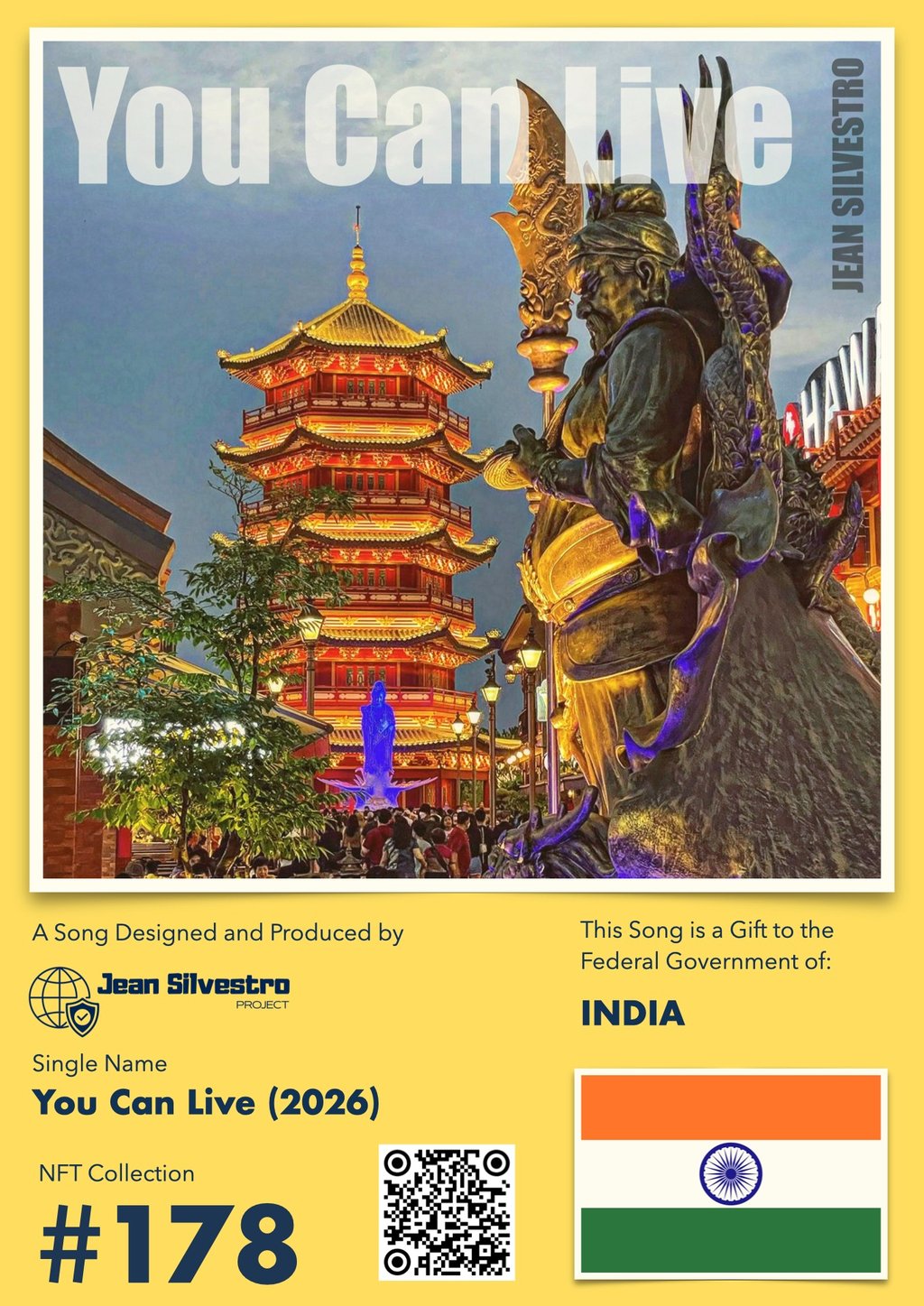
#178 You Can Live (2026)
Lyrics
What really separates us
From now and yesterday
Never hurts or makes me be afraid
It’s like a glass that never is gonna be broken
Eternal feelings... we will live forever
Now you can draw and paint
With divine brightness
And this vibe will make you live again
You can live
You can die
You can live and die again
You can live
You can die
We’ve got the infinity in our hands
Now you can touch the rainbow
Like you never did
Living your life infinitely
There’s no pain and sorrow...
I feel there is no change
Living and Dying it’s always the same
We will play this song
In the night
I believe you will never leave this place
You can live
You can die
You can live and die again
You can live
You can die
We’ve got the infinity in our hands
So anyway we’re gonna leave
And travel ... travel in peace
The universe forever
Every time we listen to this song
And travel ... travel in peace
The universe forever
We can live
You can die
We can live and die again
We can live
You can die
We’ve got the infinity in our hands
The Secret and Inspiration
What truly separates yesterday from today? I’ve been asking myself that question since that early morning in São Paulo. Yesterday, Ruy was laughing on my makeshift mat in the garage, talking about a new guitar he wanted to buy. Today, he is just a memory. And the city keeps rushing forward as if nothing had happened. Sometimes it feels like there is an invisible glass between what was and what is — a glass that shouldn’t break, but that violence insists on shattering.
I knew Ruy before everyone else knew the artist. Before the newspaper covers, before the tributes on social media. To me, he was just the guy with long, straight black hair, always tied back, a soft voice, and a gaze too calm for the jungle that is São Paulo. Me, a jiu-jitsu fighter, used to training defense, discipline, and reaction. Him, a heavy metal guitarist, a talented tattoo artist, a visual artist who spent days painting giant Carnival floats. While I released energy on the mat, he spread calm into the world.
We used to hang out in a group. Jean, Caio, Bruno, Renata, Andreia, Camila. Late nights on Augusta Street, beer spilling across the table, loud music. Jean sometimes went too far, laughed loudly, talked about projects, daydreamed. Ruy stuck to soda. Always soda. I never saw him raise his voice. I never saw him lose control. He observed, smiled, and sometimes made a sharp comment that silenced everyone. It was as if he existed on a different frequency than ours.
I have a tattoo he did on my right arm. Jean has another one on his body as well. His hand was steady, but light. He drew like someone meditating. The studio smelled of ink, coffee, and faint incense. The walls were covered with his own artwork and photos of guitars. Sometimes, after closing the studio, he would pick up his guitar and play heavy riffs with an almost absurd serenity. Heavy metal coming from someone who looked like a monk.
That February, he was working in a samba school warehouse in the North Zone. It was the peak of Carnival preparations. Giant floats, styrofoam, paint, iron, welding, sweat. He loved it. He said it was popular art on a monumental scale. While the city debated football, politics, and crisis, he was there, painting colors that would shine on the avenue.
São Paulo has this nervous energy. Organized fan groups, old rivalries, people armed for nothing. That night turned into chaos far too quickly. I didn’t see it, and I don’t want to imagine every detail. I only know that a rival group invaded the warehouse. Shouting. Running. And in the middle of it all, Ruy — who was there only to work, only to create beauty — was hit. A shot. A mistake. An absurdity.
When the news arrived, no one believed it. It didn’t make sense. It didn’t add up. How could someone who radiated peace simply by existing die in a fight that wasn’t even his? The television showed aerial images of the warehouse, reporters talking about urban violence, organized fan groups, crime. But no camera captured who he really was. No headline explained the softness of his voice.
At the wake, Jean remained silent for what felt like an eternity. Caio cried without trying to hide it. Renata held Andreia’s hand. I looked at the body lying there and thought about how much energy still existed in the memories. It seemed impossible that that calm had been interrupted by something so brutal. The body there didn’t match his story.
Since then, every time I hear a distorted guitar, I remember his calm smile. Every time I look at the tattoo on my arm, I feel as if the glass was never truly broken. The city remains chaotic. The violence remains absurd. But there is something they couldn’t take away.
You can live. You can die. But some presences don’t end with the body. We carry infinity in our hands when we say his name, when we play the songs he loved, when we tell stories of those late nights in greater São Paulo. Ruy’s body fell that night. But his vibration — gentle, steady, eternal — continues to travel with us. Travel in peace, my brother.
Days after the funeral, when the city had already swallowed another tragedy, someone showed up at Ruy’s studio asking about him. His name was Arjun Mehta. Short, steady gaze, sun-marked skin, carrying a light accent and an uncomfortable silence. He said he came from India. He said he was family. No one there really knew how. He didn’t show grief the way we did — he showed purpose. While we were still trying to understand what had happened, he already seemed to know something was wrong.
Arjun didn’t trust the official version. To him, it hadn’t been a mistake, nor an accident in the middle of a clash. He asked to see the studio, the drawings, Ruy’s notebooks. He spent hours analyzing details that, to us, were just art. Lines, symbols, patterns repeated across different works. That’s where he found something strange: maps hidden in tattoos, codes embedded in what looked like abstract strokes. Ruy wasn’t just creating art — he was recording something.
Little by little, Arjun began to build a narrative no one wanted to hear. He said Ruy had uncovered illegal routes operating within the city itself. Children disappearing without noise, forged documents, silent transportation. Destinations: ports in Europe. According to him, this wasn’t an isolated crime — it was an organized structure, protected by invisible layers. And somehow, Ruy had gotten too close. Maybe unintentionally at first. Maybe just by observing. But enough to become a risk.
The most disturbing part wasn’t the theory. It was what started happening afterward. Arjun began to be followed. Cars appearing in the same places, people watching for too long. One night, the studio was broken into — nothing stolen, nothing destroyed, but everything out of place. Like a warning. As if someone wanted to say: we know you’re looking. And even then, Arjun didn’t back down. On the contrary — he seemed closer and closer to something that could no longer be ignored.
The last time I saw him, he handed me a folded piece of paper. He only said: “If something happens to me, this needs to continue.” I never opened that paper. Maybe out of fear. Maybe because I knew that from that moment on, there would be no turning back. Because deep down, all of us felt that Ruy’s death was not the end of a story… it was the point where it became too dangerous to be told.
India - Performance
Each country profile presents the most recent data available on a range of indicators relating to the well-being of women and children. Each country profile page is composed of data from multiple sources, depending on the indicator domain. For example, child mortality rates come from the most recent data produced by the UNICEF-led Inter-agency Group for Child Mortality Estimation (IGME).
SDG indicators related to children
The 2030 Agenda includes 17 Global Goals addressing the social, economic and environmental dimensions of sustainable development. Attached to the Goals are 169 concrete targets measured by 232 specific indicators.
To map and monitor how ambitious and realistic countries’ targets are, UNICEF has created quantifiable country-level benchmarks for child-related indicators for which data are available to measure and monitor child rights on a common scale.
Below is a snapshot of the country’s performance against the 45 child-related SDG indicators, grouping results into five areas of child well-being to provide an overall assessment of how children are doing. Countries are assessed using global and national targets. The analysis provides valuable insights into both historical progress—recognizing the results delivered by countries in the recent past—and how much additional effort may be needed to achieve the child-related SDG targets. This approach provides a framework for assessing ambition as well as the scale of action needed to achieve it.
Jean Silvestro Project • 2025 • All Rights Reserved
The project is currently in the institutional consolidation phase, with legal and structural developments underway.