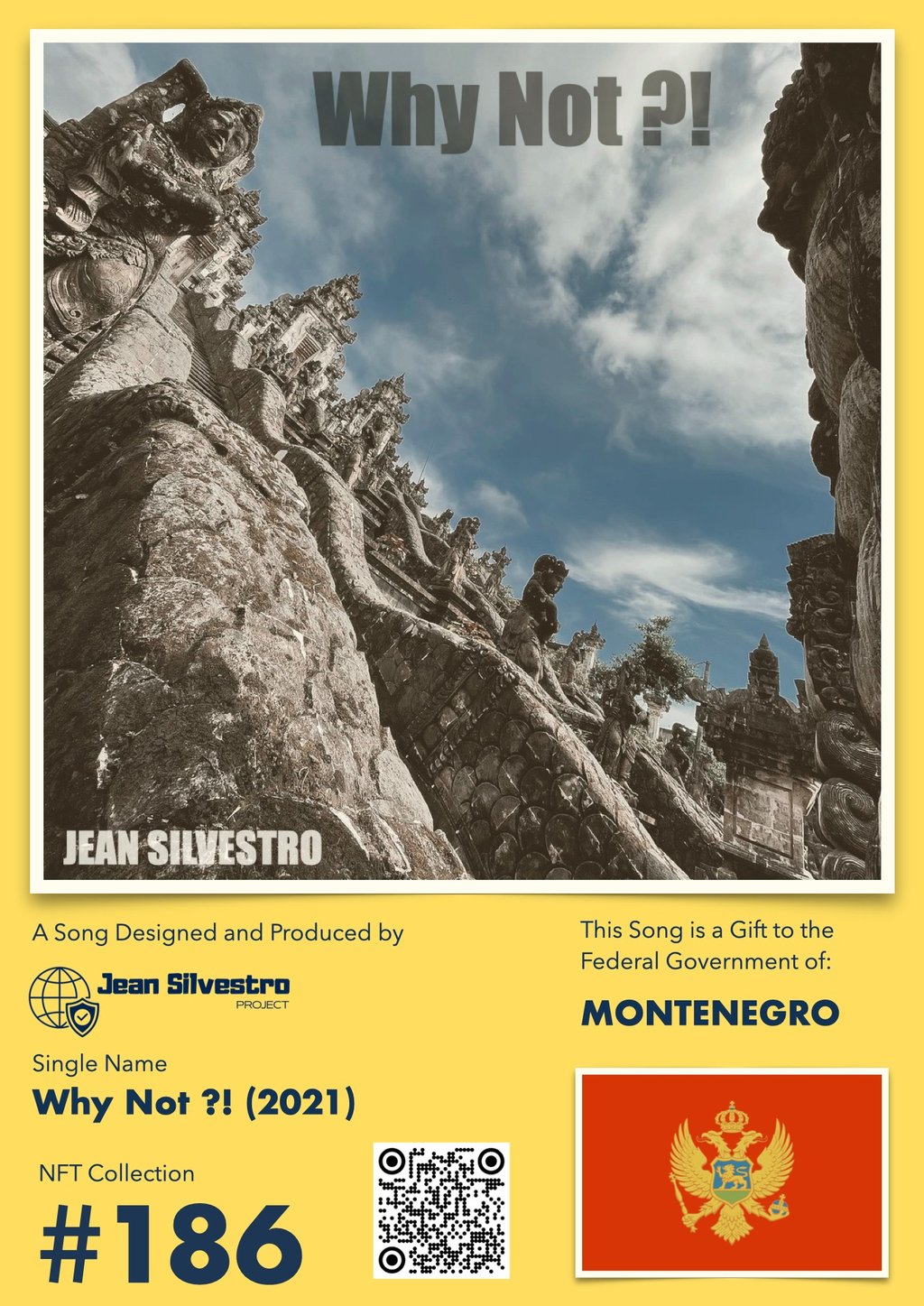
#186 Why Not ?! (2021)
Lyrics
Why not
Why not
Why not
My life is like an empty river
Nobody sees, they can’t hear my voice
I’m getting thirsty, I’m getting too diseases
This life is really too short
I think this time I’m really leaving
I heard the cry and scream form my mom
Her tears are dropping, dropping on my face now
She cannot save me anymore
She cannot save me anymore
Why don’t you save me
Save me
I just need clean water
Give me
One more chance Bro
Why not
I could be proud of you
Why Not
If you come now I should be here
But if you don’t I can’t breathe anymore
No matter what you bring me I´m still here
But time is so fast running out
Too late for me, just bring me flowers
Please dry these tears of me from my mom
Why don't you bring clear water
Why not
What do you are waiting for
Why not
Why don’t you save me
Save me
I just need clean water
Give me
One more chance Bro
Why not
I could be proud of you
Please Bro, save me
Now Bro
I just need clean water
Give me
One more chance Bro
Why not
I could be proud of you
What do you are waiting for
Why Not
The Secret and Inspiration
His name was Dawit. He was five years old and didn't exactly know what it meant to die. He only knew that he had been thirsty for many days. A thirst that wouldn't be quenched by promises. A thirst that wouldn't be quenched by waiting. A thirst that made his tongue stick to the roof of his mouth as if someone had glued sand inside. The sun in the Afar region didn't burn. It crushed. The earth was open in deep cracks, as if the ground itself had tried to drink and failed.
The air was too dry to carry hope. Flies landed in the corners of Dawit's eyes, but he no longer had enough energy to swat them away firmly. He only moved his fingers slowly, as if he were underwater—an irony he didn't understand.
He was in his mother's lap. His body was too light for a five-year-old boy. Light as a bundle of twigs. Light as something that is already leaving. His mother held his face in her hands and spoke things he didn't fully understand. Her voice trembled, and the words came mixed with sobs. Tears streamed down Dawit's face. Water. But not the right water.
He opened his eyes with effort. Everything seemed distant, as if the world were silently receding. That's when he saw the cameras. Large. Black. With round eyes pointed at him. Men in vests and microphones spoke in languages he didn't know. One of them gestured wildly. Another looked at the framing and adjusted the focus.
Dawit didn't know what an audience was. He thought they were doctors. Or maybe important men bringing trucks with clean water. He tried to raise his hand. He couldn't quite manage it. His hand trembled in the air. "Why not…" he murmured, almost soundlessly.
One of the journalists moved closer, knelt down to get a close-up. The mother noticed the movement and said something desperate, pleading for help. The journalist maintained a professional gaze. Tragic. Impactful. Perfect for the evening news. Dawit felt a sharp pain in his chest. It wasn't exactly pain—it was shortness of breath. Each breath came short, irregular, as if the air had become too thick to pass through his lungs. He looked at the man with the camera. "Save me…" he whispered. The lens zoomed in.
His mother was now crying uncontrollably. Tears continued to fall down her son's face. He felt the moisture trickle down to the corner of his mouth. He tried to move his tongue to catch a drop. It was no use. He thought that perhaps, if he asked properly, they would bring water. "I just need clean water…" his voice faltered mid-sentence. The journalist swallowed hard, but didn't lower the camera. Dawit looked at the sky. Too blue. Too big. Too indifferent.
His heart beat fast, then slower, then irregularly. He didn't understand why no one brought water. He didn't understand why there were enough men to film, but not to save. In his mind, the world was simple: If someone can help… they help. He thought of his mother. "I didn't want her to cry. — I could be proud of you… — he murmured to the camera, believing that someone important was on the other side.
The world began to darken at the edges. The mother was screaming now. A scream that tore through the dry air. One of the journalists looked away for a second. Another continued filming. This was too real not to be shown. Dawit felt his body grow cold, despite the heat. He tried to take another breath. It didn't come. Silence. The mother pressed the small body against her chest. She rocked back and forth, as if she could still cradle life back into him. The camera continued recording. Cut.
Hours later. In a distant country, a fictional president of a developed nation sat in an elegant room. Leather sofas. Polished wooden table. A glass of ice water slowly sweating beside the remote control. The news report went on air. “Humanitarian crisis in Ethiopia. Child dies due to lack of access to drinking water…” Dawit's face appeared on the screen. Close-up. Dry eyes. Chapped lips. A small hand trembling.
The president watched for a few seconds. His expression was neutral. Calculated. Tired. An advisor was in the background, talking about numbers, about the budget, about strategic priorities. On TV, Dawit's weak voice echoed: "Why don't you save me…" The president picked up the glass of water. Took a sip. The ice clinked. On the screen, his mother screamed. He sighed. He picked up the remote control. Changed the channel. A debate program began. Then a game show. Then commercials. The room remained comfortable. In Ethiopia, Dawit's body was already motionless.
In the world's digital memory, he would become a statistic. But the question didn't die. It crossed continents. It crossed screens. It crossed consciousness. And it remained suspended in the air, too simple to be ignored, too uncomfortable to be answered: Why not.
Montenegro - Performance
Each country profile presents the most recent data available on a range of indicators relating to the well-being of women and children. Each country profile page is composed of data from multiple sources, depending on the indicator domain. For example, child mortality rates come from the most recent data produced by the UNICEF-led Inter-agency Group for Child Mortality Estimation (IGME).
SDG indicators related to children
The 2030 Agenda includes 17 Global Goals addressing the social, economic and environmental dimensions of sustainable development. Attached to the Goals are 169 concrete targets measured by 232 specific indicators.
To map and monitor how ambitious and realistic countries’ targets are, UNICEF has created quantifiable country-level benchmarks for child-related indicators for which data are available to measure and monitor child rights on a common scale.
Below is a snapshot of the country’s performance against the 45 child-related SDG indicators, grouping results into five areas of child well-being to provide an overall assessment of how children are doing. Countries are assessed using global and national targets. The analysis provides valuable insights into both historical progress—recognizing the results delivered by countries in the recent past—and how much additional effort may be needed to achieve the child-related SDG targets. This approach provides a framework for assessing ambition as well as the scale of action needed to achieve it.
Jean Silvestro Project • 2025 • All Rights Reserved
The project is currently in the institutional consolidation phase, with legal and structural developments underway.